




Touchless Fixtures & Hygiene: An AEC Specification Guide
The specification process of touchless faucets and soap dispensers is not just about choosing fixtures. It is about treating these everyday objects as building assets that support hand hygiene, accessible use and maintainable operation in high-traffic restrooms.


Hands-Free Operation
By removing the need to operate a faucet handle or soap pump, touchless systems reduce contact with those shared controls.
Contact Reduction
Reducing contact with shared controls can support a hand-hygiene strategy, but does not establish a measured reduction in infections. Basin surfaces, doors and other contact points still need appropriate cleaning.
Commissioning: test hand entry, withdrawal and repeat activation using the finished basin and lighting. Record missed activations, unintended flow and shutoff behavior separately. Keep the usable washing zone clear of the basin rim and adjacent dispensers.

Consistent Handwashing
Properly selected and commissioned foam dispensers can provide repeatable doses for more controlled use. The required dose depends on the soap formulation and its instructions.
Dose Verification
Check dose repeatability with the specified soap at full and low reservoir levels and after idle periods. Consistency supports predictable operation; it does not prove that every user follows an effective handwashing technique.
Measurement: collect a defined sequence of doses in a tared container and divide net mass by the number of activations. Report dose mass and variability; foam volume alone includes air and is not equivalent to liquid soap quantity. Check first-dose recovery after standby separately.

Integration Across Systems
Coordinating touchless faucets, dispensers and flush controls can reduce the number of shared controls users need to touch.
System Coordination
Coordinate the full user sequence, from flushing to washing and drying. Touchless controls do not remove contamination from surfaces or eliminate the need for cleaning, ventilation and maintenance.
Interfaces: coordinate supply connections, power kits, cleaning modes, sensor zones, soap refill routes and isolation valves. Test neighboring stations individually and together. Do not infer that a faucet pictured here includes a flush valve.

Healthcare-Grade Reliability
In hospitals, clinics, and schools, properly specified fixtures support safer restroom operation.
Clinical Reliability
Assess clinical applications with the facility’s infection prevention and water management teams. “Healthcare-grade” is a design objective here, not a certification or a claim that the illustrated product meets a particular clinical standard.
Risk review: review splash, drain position, outlet configuration, clean-supply storage and stagnation with the clinical team. CDC healthcare water guidance supports a facility water management program and deliberate sink design.

User Confidence
Visible cleanliness and predictable hands-free operation can support user confidence. Perceived hygiene and measured infection risk are different outcomes.
User Interaction
The original article stated that “over 70%” of people perceive touchless restrooms as cleaner and safer. It did not identify the study, sample or survey date. That figure is retained here as an unverified original claim, not a validated statistic or chart input.
Usability: observe whether users can locate the activation zone, receive soap without repeated attempts, rinse comfortably and reach drying equipment. Record user feedback alongside faults and downtime rather than treating a perception score as clinical evidence.

Specification Value
Well-specified touchless faucets and dispensers do more than complete a restroom.
Lifecycle Performance
Treat fixtures as part of a broader public-health and facilities strategy. Evaluate operating reliability, cleaning, water use, consumables, service access and the ability to maintain performance over the service life.
Procurement: require exact model numbers, outlet options, power arrangements, compatible consumables, replacement-part references and installation drawings. Compare lifecycle cost using documented maintenance and replacement assumptions rather than purchase price alone.

Strategic Value for High-Traffic Restrooms
Well-specified touchless faucets and dispensers contribute to public-health objectives by supporting usable handwashing stations. Reliable activation, available soap, effective drying, clean surfaces and timely maintenance must work together. A touchless designation alone does not make a restroom safe or germ-free.


Engineering the Handwashing Station
Technical Criteria Beyond Touchless Activation
The faucet, dispenser, basin, water supply and maintenance arrangement form one assembly. Define its operating conditions before selecting a finish or control technology. Product images in this article remain illustrative manufacturer references; they do not establish certification, clinical suitability or measured performance.
Hydraulic Performance
Specify the outlet flow together with its rating pressure. Check dynamic pressure while neighboring fixtures operate, including losses through strainers, mixing devices and supply pipework. Low pressure, obstructed filters and an unsuitable outlet can change the user experience.
Measure actual flow with a timed collection or a suitable flow meter. Record the outlet configuration and supply conditions so the result can be reproduced after maintenance.
Basin and Splash Geometry
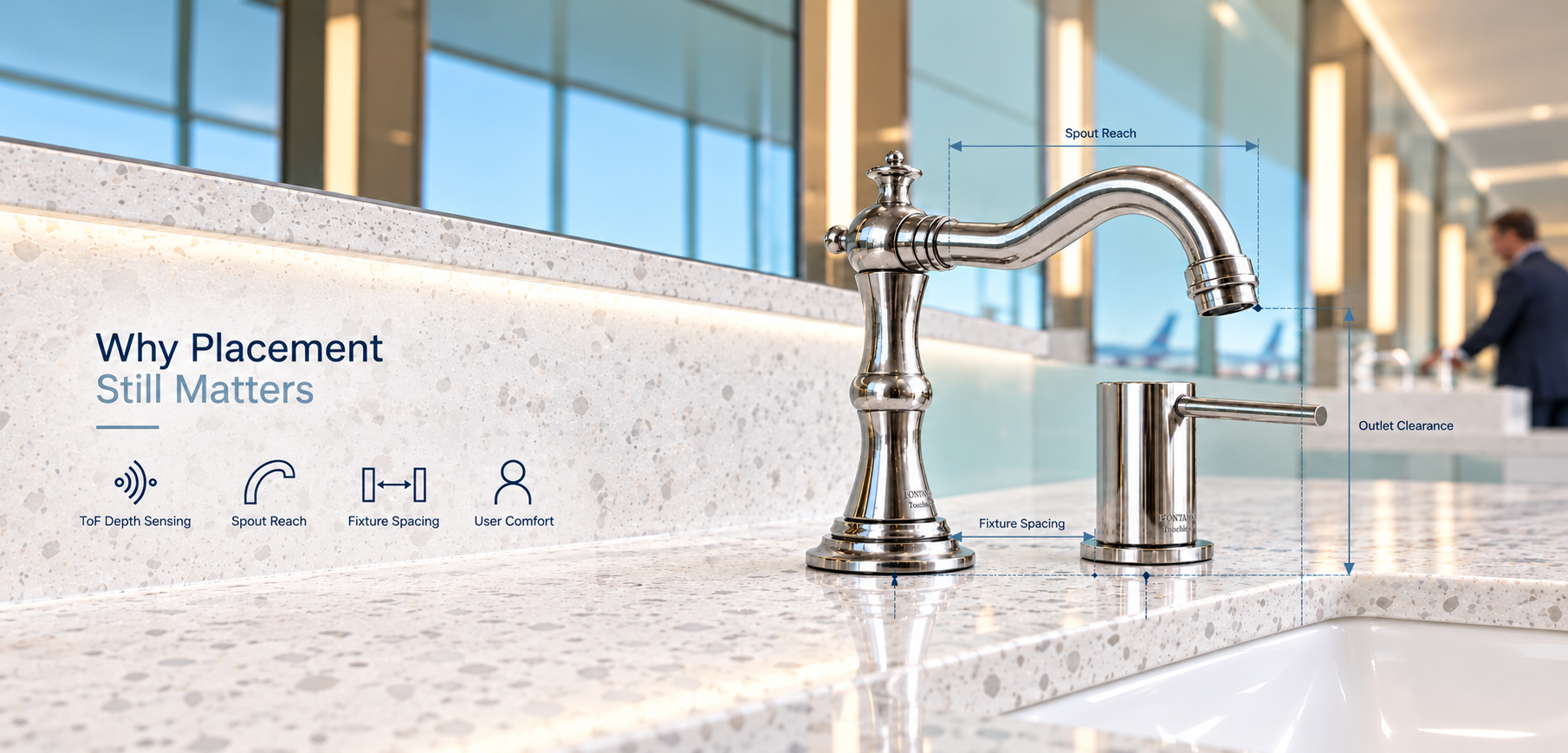
Coordinate spout reach, outlet height, stream direction, drain location and hand clearance. Test the completed basin-and-faucet pairing: a fixture that works with one bowl can splash when installed over another.
In healthcare, use the project risk assessment to evaluate splash exposure and sink location. Follow CDC water-management considerations ; a contactless sensor does not resolve drain-related hazards.
Accessible Reach and Clearance
Coordinate the finished counter, knee and toe space, approach area, exposed pipes and reach to soap and drying equipment. Keep control boxes and reservoirs out of required clearance zones.
Review the assembly against the U.S. Access Board lavatory guide . A product labeled accessible cannot compensate for an inaccessible installation.
Temperature and Power
Identify the mixing and temperature-limiting arrangement, its minimum operating flow and its approved installation conditions. Verify delivery temperature under the project’s expected supply conditions.
Specify the exact battery, transformer or other power kit. Check loss-of-power behavior, restoration, low-battery indication and service access. AC/DC options do not necessarily mean automatic backup.
Soap Compatibility and Refill Hygiene
Confirm approved formulation, viscosity range, reservoir arrangement and refill method. Look for delayed delivery, lost prime, outlet dripping and changed dose after standby or low fill.
For healthcare, CDC clinical hand-hygiene guidance advises against adding soap to partially empty dispensers. Follow the specified cleaning and refill procedure; sensor activation does not sanitize the reservoir.
Cleaning and Service Access
Use manufacturer-approved cleaning methods for finishes and optical windows. Identify whether cleaning mode is available and how staff can isolate a faulty station without disabling an entire restroom.
Provide access to strainers, valves, electronics and dispensers without removing finished counters. Handover should include spare-part identifiers, settings, cleaning instructions and a maintenance responsibility schedule.
From Submittal to Handover
Commissioning and Operational Verification
Define the test conditions. Record model, outlet, basin, soap, power arrangement, supply pressure, lighting and controller settings. Establish acceptance criteria in the project specification; this article does not assign unsupported universal sensor ranges or response times.
Separate the events. Observe detection, water or soap delivery, user withdrawal and final shutoff as different events. A fast detection response does not necessarily produce immediate fluid delivery, particularly where a dispenser must recover prime.
Test normal and challenging use. Include adjacent-station operation, pass-by movement, cleaning, low reservoir level, first use after standby and service replacement. Record failures with their conditions so corrective changes can be verified.
Maintain the result. Repeat relevant checks after changing an outlet, sensor, controller, pump, soap formulation or basin component. Follow the facility water management plan for flushing and monitoring; automatic purge is only one possible control.
Related technical reading: specifying touchless faucets and soap dispensers and architectural teams and commercial fixture coordination .
Technical Data Appendix
Graphs, Pie Chart and Specification Tables
Water-On Time and Daily Demand
Assumptions: 0.5 US gpm; 500 events/day; constant flow; excludes cleaning, purge, leakage and repeat activations. Bars share a zero-to-100-gallon/day scale.
Illustrative Station Water Budget
Example total: 60 US gallons/day. Washing uses the 12-second case; purge and cleaning are additional assumed allowances.
- Blue — washing: 50 gal/day · 83.33%
- Teal — purge: 5 gal/day · 8.33%
- Gold — cleaning: 5 gal/day · 8.33%
| Case | Flow | Water-on time | Events/day | Daily water |
|---|---|---|---|---|
| A | 0.5 gpm | 10 s | 500 | 41.67 gal |
| B | 0.5 gpm | 12 s | 500 | 50.00 gal |
| C | 0.5 gpm | 20 s | 500 | 83.33 gal |
| Pie-chart total | Case B + 5 gal purge + 5 gal cleaning | 60.00 gal | ||
| Parameter | Check or measurement | Record for handover |
|---|---|---|
| Activation | Hand entry, pass-by movement and neighboring stations. | Detection settings; missed and unintended activations. |
| Flow and shutoff | Timed collection; withdrawal response; maximum run time. | Outlet identity, pressure, measured flow and timing. |
| Soap delivery | Repeated doses; first dose after standby; low reservoir. | Soap formulation, mean dose mass, variation and recovery. |
| Basin coordination | Hand clearance, stream impact and splash observation. | Basin model, mounting dimensions and mock-up findings. |
| Accessibility | Approach, finished dimensions, reach and pipe protection. | Coordinated drawings and completed-installation checks. |
| Temperature | Delivery temperature at the specified operating conditions. | Mixing device, settings and measured temperatures. |
| Power and servicing | Power interruption; battery or transformer replacement. | Failure behavior, access method and replacement parts. |
| Cleaning | Approved cleaner, optical-window care and refill procedure. | Cleaning instructions, staff training and assigned owner. |
Touchless Bathroom Fixtures for Cleaner Commercial Handwashing Environments
Touchless fixtures are becoming an important part of commercial restroom design because they reduce the need to operate shared faucet handles and dispenser controls. Coordinated sensor faucets and automatic soap dispensers can support a more hygienic handwashing process while helping facility teams manage water flow, soap consumption, cleaning requirements and daily operational demands.

Fontana Creteil Chrome Deck-Mounted Automatic Faucet and Foam Soap Dispenser
Coordinated Water and Foam Soap Delivery
The combined water and foam-soap arrangement offers a practical alternative to separate handwashing fixtures. Independent hands-free functions help reduce contact with shared controls, while the chrome brass body fits a contemporary commercial restroom. The multi-voltage power arrangement is particularly relevant where electrical coordination varies across building projects.View Live Product →

Fontana Creteil Chrome Digital Display Sensor Faucet and Automatic Soap Dispenser
Modern Commercial Handwashing Technology
This digital-display configuration brings a more technology-led appearance to commercial handwashing areas. The coordinated faucet and soap dispenser arrangement supports touch-free operation while allowing architects to specify a consistent visual system. Technical documentation and installation resources are useful for planning the fixture within larger restroom renovation projects.View Live Product →

Fontana Solo Matte White Touchless Faucet and Automatic Soap Dispenser
Minimalist Appearance With Practical Hygiene
The matte-white finish allows this coordinated handwashing system to blend into bright modern interiors without creating excessive visual contrast. Touchless water and soap operation supports a lower-contact washing sequence. Its architectural styling makes it worth considering for healthcare-inspired interiors, hospitality spaces and minimalist public restrooms where appearance and hygiene are equally important.View Live Product →

Fontana Chrome Deck-Mounted Commercial Touchless Sensor Faucet and Soap Dispenser
Adjustable Detection for Busy Restrooms
The commercial deck-mounted arrangement combines touchless water operation with hands-free soap dispensing. Adjustable sensor distance is valuable during commissioning because basin depth, hand position and reflective surfaces can influence activation behavior. The manufacturer also lists multiple power options and anti-leak features, giving specification teams useful considerations for high-traffic installations.View Live Product →

Fontana AutoLume Chrome Motion Sensor Faucet With Automatic Soap Dispenser
Infrared Activation for Cleaner Shared Spaces
The AutoLume system emphasizes infrared activation and a coordinated approach to water and foam-soap delivery. Its chrome finish suits commercial spaces that require a familiar, easy-to-coordinate architectural appearance. The hands-free arrangement supports reduced contact with restroom hardware, making it relevant to offices, hospitality facilities and other shared washing environments.View Live Product →

Fontana Sète Polished Chrome Automatic Sensor Faucet and Touchless Soap Dispenser
Reliable Sensor Operation With a Clean Finish
Professional customer feedback on the product page highlights the substantial construction, responsive hands-free operation and clean appearance of the chrome finish. The customer was particularly positive about the sensor performance and the way the coordinated faucet and dispenser maintained a streamlined architectural appearance.View Live Product →