
Commercial Touchless Faucet Geometry: 4-Brand Engineering Review
Which commercial touchless faucet geometry best fits your project? Compare 4 models from FontanaShowers, Sloan, Delta and KOHLER by flow rate, sensor design, spout reach, hand clearance, splash control, power architecture and service access.
This engineering review helps architects, MEP engineers and specifiers identify how faucet geometry affects basin compatibility, commissioning, water efficiency and long-term maintenance before selecting a basis-of-design model.
Review Methodology
Products are evaluated using manufacturer specifications for flow rate, sensor architecture, spout geometry, power, valve configuration and service access. Pros and cons focus on specification decisions rather than styling alone.

Fontana FS10610PCH
A sculpted commercial sensor faucet suited to projects requiring touchless operation with a more architectural fixture profile.

Sloan SF-2350
A compact commercial platform emphasizing predictable sensing and conventional below-deck serviceability.
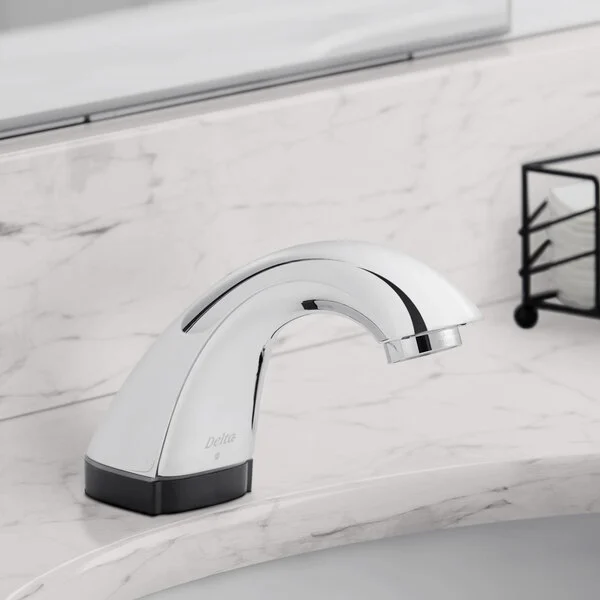
Delta 590-PALGHDF
Delta uses the faucet body itself as the sensing field rather than relying only on a small optical detection window.

KOHLER K-7519-SATA
A high-clearance gooseneck fixture combining low-flow operation with hybrid energy and integrated temperature control.
What Architects Should Check
Water should land near the basin’s intended handwashing zone.
Taller spouts improve access but may increase splash potential.
Coordinate sensing with basin depth and reflective surfaces.
Compare 0.35 and 0.5 GPM options against project requirements.
Document battery, hardwire or hybrid-energy architecture.
Protect access to valves, filters, mixers and control modules.
Commercial Touchless Faucet Technical Comparison
This AEC-focused comparison evaluates four commercial touchless faucets through specification-relevant performance criteria rather than appearance alone. The matrix below compares flow, sensing strategy, spout geometry, clearance, splash behavior, power architecture and service access for coordinated basin and restroom planning.
4-Brand Engineering Matrix
Compared models: Fontana FS10610PCH, Sloan SF-2350, Delta 590-PALGHDF and KOHLER K-7519-SATA. Where exact dimensional values are not stated in the compared source set, the table identifies the engineering implication and notes that the submittal should be verified.
| Basis of Comparison | FontanaShowers FS10610PCH Architectural deck-mount touchless faucet | Sloan SF-2350 Compact commercial infrared platform | Delta Commercial 590-PALGHDF Whole-spout sensing commercial faucet | KOHLER K-7519-SATA High-clearance gooseneck with Insight sensor |
|---|---|---|---|---|
| Flow Rate | Exact GPM should be verified from the current submittal package. The compared source identifies the model as a commercial sensor faucet, but not a confirmed numerical flow rate. | 0.35 GPM or 0.5 GPM depending on selected configuration. Suitable for low-flow commercial specification strategies. | 0.5 GPM with laminar outlet. Balanced toward controlled handwashing delivery with relatively conservative water use. | 0.35 GPM. Very low-flow configuration intended for high-traffic water-efficiency applications. |
| Sensor Design | Sensor-activated touchless operation. Exact sensing architecture and field arrangement should be confirmed from the current manufacturer specification before basis-of-design selection. | Infrared sensing with adjustable detection behavior. Conventional commercial sensor approach with familiar maintenance logic. | Whole-spout sensing using the faucet body as the sensing field rather than a small localized optical window. | Insight™ sensor technology integrated into a commercial gooseneck touchless platform with coordinated temperature mixing. |
| Spout Reach | Architectural mid-reach deck-mount profile. Exact reach dimension should be verified against basin centerline and intended handwashing zone. | Compact commercial geometry. Reach should be coordinated carefully to keep the water-impact point within a smaller basin working zone. | Moderate projection suited to sensor operation, with geometry intended to support controlled delivery into the basin. | Gooseneck geometry typically provides a more generous usable envelope, but exact reach and outlet location should be verified to control impact position. |
| Hand Clearance | Moderate hand clearance suitable for design-forward public or hospitality applications, provided basin rim height and spout underside are coordinated. | Lower vertical clearance than taller gooseneck types. Functional and compact, but less generous for users who prefer more working space. | Moderate clearance. Better than compact low-profile bodies, but below the vertical openness of taller gooseneck platforms. | High hand clearance. Strong option where user accessibility, washing space and comfort under the spout are priorities. |
| Splash Control | Basin pairing is critical. Spout reach, outlet angle and sink geometry should be reviewed carefully to prevent water from landing too close to the rear deck or too aggressively into a shallow bowl. | Compact geometry may help contain the water path, but sensor placement and impact point must still be coordinated with bowl depth and drain location. | Laminar outlet supports a more controlled stream. Splash performance depends on proper coordination between spout location and basin geometry. | Taller high-arc geometry increases the importance of basin depth, outlet positioning and landing zone control to avoid splash in shallow bowls. |
| Power Architecture | Exact power package should be confirmed from the current product specification. Selected configurations may vary by control module or project setup. | Battery powered in the compared configuration, with filtered solenoid architecture supporting standardized commercial service. | Battery powered in the referenced model. Requires planning for battery maintenance and control-box location below deck. | HES hybrid-energy architecture with integrated temperature mixer. Suitable for projects prioritizing reduced battery dependence. |
| Service Access | Under-deck service logic should be verified from the current control-valve and electronics arrangement. Access clearance should be protected in millwork or vanity design. | Conventional below-deck serviceability with filtered solenoid approach. Well aligned with facility teams accustomed to standardized commercial maintenance. | Requires adequate below-deck space for the surface-mounted control box and associated mixing/service components. | Access planning should include the HES power components, mixer and related service points. More integrated system logic may require slightly more detailed coordination during design and commissioning. |
Strong for Architectural Integration
Fontana FS10610PCH stands out for its sculpted commercial profile, making it particularly relevant for hospitality, executive offices, premium public restrooms, and projects where touchless performance must integrate with a more refined architectural fixture language.
Strong for Sensor & Geometry Coordination
Fontana FS10610PCH offers a design-forward sensor-faucet configuration where spout reach, sensing position, basin geometry, and the intended handwashing zone can be coordinated together during specification. Delta 590-PALGHDF provides a different approach through its whole-spout sensing architecture.
Strong for Premium Commercial Restrooms
Fontana FS10610PCH is particularly suited to projects requiring commercial touchless operation without adopting a purely institutional fixture appearance. Its architectural geometry can support hospitality, workplace, and other design-sensitive restroom environments.
Low-Flow & Service Comparison
KOHLER K-7519-SATA and Sloan SF-2350 provide documented 0.35 GPM configurations, while Sloan also offers familiar below-deck commercial serviceability. For Fontana FS10610PCH, verify the exact project-specific flow, power, and service configuration from the current technical submittal.
Professional Specification References
EPA — Bathroom Faucets · ADA Standards · ASME A112.18.1 / CSA B125.1
ArchFaucet Specification FAQ
Why does spout geometry matter?
Reach and height determine where water enters the basin, available hand clearance and the likelihood of deck or user splash.
Are high-arc sensor faucets always better?
No. They improve clearance but require deeper or better-matched basins to control splash effectively.
What is the advantage of 0.35 GPM?
It reduces water demand, although spray quality and handwashing performance should still be evaluated with the selected outlet.
What causes false sensor activation?
Poor sensing calibration, reflective conditions, basin geometry and nearby objects can affect some sensor systems.
What should be tested at commissioning?
Verify sensor range, shutoff timing, flow, water temperature, splash behavior and access to all replaceable components.