
Touchless Fixture Reliability Under Heavy Traffic: What Happens When Thousands of Users Arrive
A touchless faucet may perform perfectly during normal building traffic and still become
a major operational problem during halftime, an airport departure wave, a convention break
or a sold-out arena intermission. In very large venues, reliability must be measured under
repeated peak-load operation—not occasional activation.
A Reliable Fixture at Noon May Not Be Reliable at Halftime
Stadiums, arenas, airports and convention centers subject electronic restroom fixtures
to an unusual operating pattern. Demand can remain moderate for long periods and then
accelerate dramatically when thousands of users enter restroom banks within minutes.
During those waves, faucets, automatic soap dispensers, flush valves and hand dryers can
cycle continuously. Every sensor delay, false activation, weak battery or partially
obstructed outlet becomes more visible because the same problem is multiplied across
dozens or hundreds of fixtures.
“Does the sensor work?” The better question is whether the entire touchless fixture
system continues working predictably through repeated high-volume event cycles.
The Six Failure Modes Facility Teams Notice First
“`
Inconsistent Detection
A faucet that activates immediately for one user but hesitates for the next creates
confusion and slows the wash-station sequence during concentrated traffic.
False Activations
Poorly controlled sensing may trigger water, soap or flushing without an intentional
user interaction, increasing consumption and unnecessary fixture cycling.
Battery Depletion
Battery-only architecture can become a substantial maintenance burden when hundreds
of electronic fixtures must remain available across a large facility.
Restricted Water Flow
Aerator contamination, debris or service issues can reduce faucet performance and
create visibly different flow from one wash station to another.
Soap Delivery Problems
Empty reservoirs or poorly maintained dispensers can remove an important part of the
handwashing sequence even while the faucet itself continues operating.
Difficult Service Access
A minor sensor, valve, cartridge or power issue becomes a larger operational problem
when technicians cannot reach service components quickly.
“`
Touchless Reliability Is a System, Not a Single Sensor
It is easy to concentrate on the infrared sensor because it is the component the visitor
experiences directly. In reality, successful automatic operation depends on a chain of
components working together.
“`
Sensor
Detects the user consistently without excessive sensitivity or unreliable activation.
Electronics
Processes the activation signal and controls the operating sequence.
Valve / Motor
Opens water, delivers soap, initiates flushing or activates drying.
Power / Water
Provides adequate energy, pressure and consumable capacity for repeated operation.
“`
Touchless Fixture Reliability Specification Matrix
A strong commercial touchless specification goes beyond appearance. Architects, MEP
engineers, plumbing consultants, contractors, procurement teams and facility managers
should evaluate expected fixture cycles, sensing behavior, service access, power strategy,
soap delivery, water control and standardization as one operating system.
“`
| Specification Priority | Why It Matters | Large-Venue Design Objective |
|---|---|---|
| Sensor Performance | Thousands of repetitive activations can occur during event surges. | Fast, predictable hands-free response across large restroom banks. |
| Fixture Durability | Public washrooms experience intensive use, cleaning and potential physical abuse. | Commercial-grade construction and finishes suited to high-use environments. |
| Restroom Throughput | Delayed or confusing fixture interaction can contribute to congestion. | Simple touchless operation that supports efficient patron movement. |
| Soap Delivery | Frequent individual dispenser refilling can increase maintenance workload. | Automatic, high-capacity or centralized soap strategies where appropriate. |
| Water Control | Unnecessary run time is multiplied across hundreds of fixtures and event cycles. | Controlled sensor-activated water delivery aligned with efficient operation. |
| Power Architecture | Battery replacement becomes increasingly significant as fixture counts rise. | Evaluate battery, AC or AC/DC strategies according to project infrastructure. |
| Serviceability | Fixture downtime is disruptive during sold-out events and short turnaround windows. | Maintenance access that supports faster sensor, valve and component intervention. |
| Standardization | Multiple unrelated sensor and valve platforms complicate spare-parts inventory. | Repeatable fixture architecture across restroom banks and facility zones. |
“`
Battery Reliability Becomes a Different Problem at Stadium Scale
A battery-powered fixture may be simple to maintain when a facility has ten units.
The maintenance equation changes when a stadium, airport or convention center has hundreds
of electronic faucets, dispensers or flush valves distributed across multiple levels.
“`
Can offer installation flexibility, particularly where hardwired power is unavailable.
The facility team should nevertheless evaluate replacement schedules, access and
inventory requirements across the entire fixture population.
Large projects may benefit from coordinated electrical infrastructure where appropriate.
Power architecture should be resolved with the MEP design rather than treated as an
afterthought at fixture procurement.
“`
“`
“`
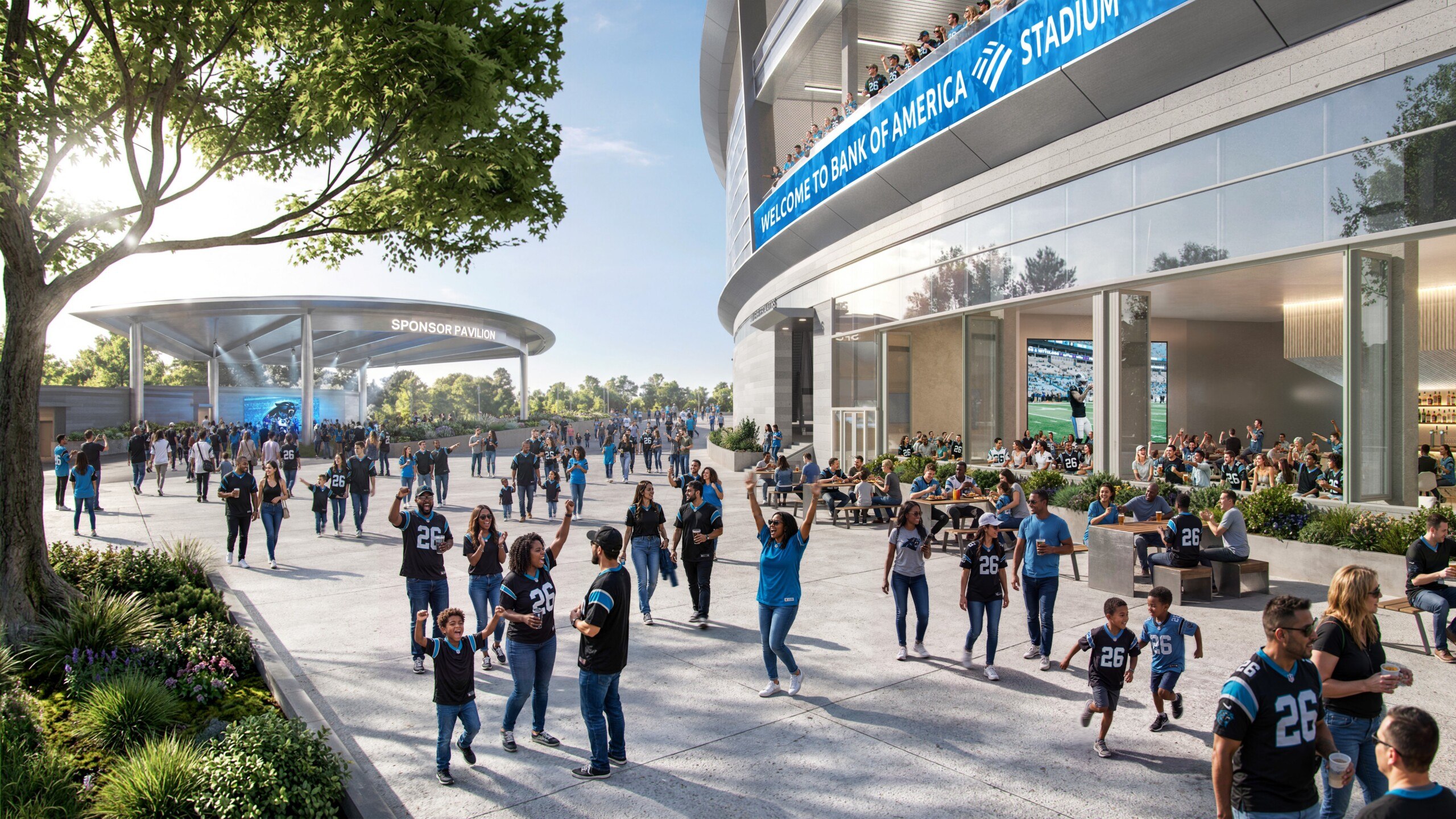
part of overall venue operations. Image source: HOK.
Maintenance Access Can Determine Whether a Small Fault Becomes Downtime
Electronic fixtures eventually require service. Sensors may need adjustment, aerators may
need cleaning, batteries may require replacement, soap systems need replenishment and
valves or cartridges may need attention.
For a facility manager, the important difference is whether those tasks take minutes or
require a restroom bank to be partially shut down. Large venues should therefore consider
service access as part of reliability—not as a separate maintenance issue.
- Accessible sensor and electronic components
- Quick aerator inspection and cleaning
- Accessible solenoids and control valves
- Predictable battery replacement procedures
- Large-capacity soap where appropriate
- Standard replacement components
- Protected wiring and electronics
- Clear facility maintenance documentation
How Commercial Brands Fit Into Reliability Planning
Manufacturer selection should follow the operating requirements. There is no automatic
winner for every stadium, arena or airport because project infrastructure, basin geometry,
electrical strategy, maintenance staffing and procurement standards vary.
“`
Relevant where the project team is considering a broader touchless washroom strategy
involving commercial sensor faucets, automatic soap dispensing, power options and
standardized large-venue restroom planning.
An established institutional platform where commercial service architecture,
vandal-resistant construction and protected electronic components may be important
specification considerations.
Provides commercial electronic faucet configurations incorporating infrared sensing,
automatic operation and configurable commercial control components.
Offers commercial touchless faucet configurations across different power and
installation approaches where performance and architectural coordination both matter.
“`
brand reputation alone does not establish large-venue reliability. Project teams should
review the exact current model documentation for sensing, power, valve architecture,
service access, flow control and replacement-parts support.
Additional Touchless Fixture Reliability Resources
Stadium Touchless Applications
Review touchless faucet and automatic soap-dispenser planning for high-traffic
stadium restroom applications.
Touchless System Evaluation
Explore stadium fixture performance through maintenance, sensing, uptime and
high-volume operational requirements.
High-Performance Stadium Operations
Connect fixture selection with peak-demand reliability, maintenance efficiency and
repeated event-cycle performance.
“`
Reliability Should Be Tested Against the Worst 15 Minutes of the Day
Large venues should not judge electronic restroom fixtures only by how they perform during
average traffic. Stadium and entertainment facilities operate in waves. The real test comes
when faucets, soap dispensers, flush valves and hand dryers are activated repeatedly while
cleaning teams, plumbing systems and maintenance staff are simultaneously under pressure.
The strongest specification therefore combines dependable sensor response, appropriate
power architecture, commercial construction, controlled water delivery, adequate soap
capacity, service access and standardized replacement components.
When those elements are coordinated correctly, touchless fixtures stop being isolated
electronic products and become part of a reliable large-venue operating
infrastructure.
Touchless Fixture Reliability FAQ
“`
Why can sensors fail more visibly during large events?
Minor response delays become significant when repeated across hundreds or thousands
of interactions during a short traffic surge.
Are batteries a reliability problem?
Not automatically, but large fixture counts can make battery replacement and
monitoring a substantial facility-management responsibility.
Can a clogged aerator affect restroom throughput?
Yes. Restricted or inconsistent faucet flow can lengthen the wash interaction and
produce uneven performance across adjacent stations.
Why does soap capacity matter?
A functioning faucet does not create a complete handwashing station if the automatic
soap dispenser is empty during peak attendance.
Why is fixture standardization useful?
Standardized platforms can simplify technician training, replacement inventory and
service procedures across a large restroom network.
What should engineers prioritize?
Consistent sensing, appropriate power, water control, accessible components,
commercial durability and maintainability under repetitive high-volume use.
“`