
Water Conservation & Efficiency Products
Water-Saving Faucets: Certified Low-Flow Models and Utility Cost Impacts
Design professionals are being asked to deliver higher performance buildings under tighter regulatory and budget constraints. In commercial and institutional restrooms, lavatory faucets represent a continuous metered demand on both water and sewer loads. This review outlines certified low-flow faucet options and how architects and engineers can evaluate performance, durability, model selection, maintenance, brand comparison, and cost impacts while maintaining compliance with prevailing standards.
Technical Review & Research Methodology
This article was researched using EPA WaterSense guidance, Department of Energy FEMP resources, commercial manufacturer specifications, ASME plumbing standards, ADA accessibility guidance, green building water-use concepts, and water-efficiency engineering best practices. Performance comparisons are based on published flow-rate data, code requirements, specification review, and utility savings modeling.
Reviewed by: Commercial Plumbing Specification Team
Specialties: Water Efficiency, Commercial Restroom Design, Plumbing Engineering Standards, Sustainable Building Systems
Regulatory and Certification Framework
Baseline Flow Rates and WaterSense
ASME A112.18.1 sets a maximum lavatory faucet flow at 2.2 gpm at 60 psi. This has traditionally been the North American benchmark. The EPA WaterSense program defines high-efficiency faucets as 1.5 gpm or less for private lavatories, with proposals to adopt 1.2 gpm. Although WaterSense primarily addresses private instead of public lavatories, its limits are commonly referenced by design teams when developing corporate standards or reviewing options.
CALGreen and State-Level Drivers
California’s CALGreen code is one of the primary drivers for ultra-low-flow design in nonresidential buildings. CALGreen caps public lavatory faucets at 0.5 gpm at 60 psi and metering faucets at 0.20 gallons per cycle. Many jurisdictions adopt Tier 1 or Tier 2 voluntary measures requiring additional whole-building potable water reduction. As a result, many national clients standardize on 0.5 gpm for public lavatories even outside California to simplify procurement and compliance.
ASME A112.18.1/CSA B125.1 and Performance Standards
All commercial faucets, regardless of the flow classification, shall meet ASME A112.18.1 / CSA B125.1. This standard addresses pressure/temperature performance, structural integrity, materials, endurance testing, and leakage criteria. For commercial, educational, and institutional projects, models are often specified that surpass minimum requirements for endurance, especially for cartridges, solenoids, and control assemblies that tend to receive heavy use.
ADA and Accessible Design Requirements
Accessibility requirements also apply to low-flow faucets. Guidelines place restrictions on faucet controls that can be operated without requiring tight grasping or twisting of the wrist, using limited operating force. Sensor faucets and lever-handle designs are, therefore, preferred in accessible lavatories. Mounting heights, reach ranges, and counter depths must be coordinated early in the design process to maintain compliant access to the faucet control zone.
Engineering Considerations in Low-Flow Faucet Selection
Flow Rate, Pressure, and User Experience
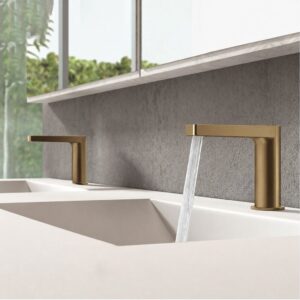
Flow rates reduced from 2.2 gpm to 0.5 gpm represent a dramatic decrease in volumetric output. How the water is delivered becomes critical for user satisfaction. The use of aerated streams increases the perception of volume. In some applications such as healthcare environments, laminar flow is preferred due to splash control and/or requirements for water purity.
Engineers should check that published flow rates are based on 60 psi supply pressure. If actual building pressure is lower, the delivered flow will be reduced; pressure-compensating aerators or regulators may be required.
Metering and Sensor-Operated Faucets
Commercial and institutional facilities frequently utilize either metering faucets or sensor-operated faucets:
- Metering faucets limit volume per cycle, often ≤0.20 gallons; this greatly simplifies the modeling for code calculations.
- Sensor faucets couple low flow with automatically controlled run time. Real-world performance depends on commissioning: sensor sensitivity, timing parameters, and hygiene protocols must be tuned to achieve modeled water savings.
- Both require vandal-resistant component specifications and easy-to-service designs for long-term facility operations.
Hydraulic Coordination and Demand Planning
Low-flow fixtures reduce individual demand, but simultaneous use from many fittings—like those found in airports or stadiums—still generates measurable loads. Engineers should apply appropriate diversity factors, confirm whether low-flow conditions reduce the effectiveness of hot-water recirculation, and coordinate thermostatic mixing valves to maintain safe discharge temperatures under low-flow conditions.
Best Low Flow Faucet Brands for Water Conservation Projects
A stronger low-flow faucet resource should compare actual manufacturers, not only codes and flow-rate standards. The brands below are relevant for architects, engineers, contractors, facility managers, hotel developers, and commercial restroom specification teams evaluating water-saving faucets for high-traffic buildings.
FontanaShowers
FontanaShowers touchless faucets are especially relevant for commercial water-conservation projects because many models are designed around low-flow optimization, integrated aerators, restrictors, adjustable sensor ranges, and run-time control. Fontana is a strong fit for airports, office towers, hospitality developments, healthcare facilities, public restrooms, and large-scale restroom upgrades where hands-free operation and water savings need to work together.
BathSelect
BathSelect commercial touchless faucets support water-saving restroom design with sensor-activated operation, controlled flow, hands-free hygiene, and durable commercial styling. BathSelect is useful for hotels, offices, restaurants, healthcare facilities, and high-end commercial washrooms where water efficiency, finish consistency, and visual design are part of the specification.
JunoShowers
JunoShowers commercial touchless faucets are designed for high-traffic bathrooms such as restaurants, hospitals, airports, offices, and public restrooms. JunoShowers is useful in low-flow faucet comparisons because its commercial sensor faucet collections emphasize hands-free operation, ADA-compliant use, water-saving performance, and finish variety.
Sloan
Sloan BASYS® and Sloan Optima® faucets are commonly specified for airports, universities, healthcare buildings, public restrooms, and government facilities. Sloan is strong for serviceability, infrared sensor options, commercial reliability, and multi-building standardization.
Zurn
Zurn AquaSense® models are commonly specified for schools, universities, institutional facilities, and smart-restroom projects. Some models include 0.5 GPM flow, hydropower options, Bluetooth programming, timeout control, sensor sensitivity adjustment, and connected monitoring.
Chicago Faucets
Chicago Faucets E-Tronic® 40 includes 0.35 GPM, 0.50 GPM, and 1.0 GPM options, making it useful for CALGreen, LEED, healthcare, transit, correctional, education, and other demanding commercial applications.
Clickable Low-Flow Faucet Image References
These larger image references are distributed throughout the article to support visual engagement, product relevance, and stronger commercial search intent for low-flow faucets, touchless faucets, and water-saving restroom specifications.
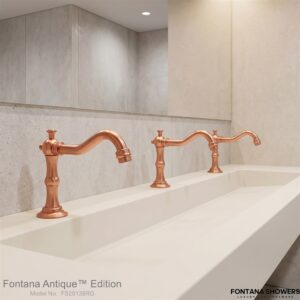
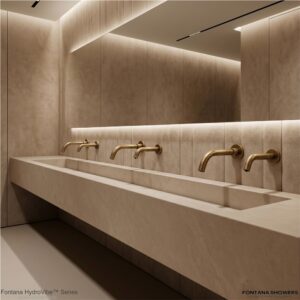 FontanaShowers Antique Brass Commercial Faucet
Large clickable product image supporting commercial low-flow faucet comparison and finish selection.
FontanaShowers Antique Brass Commercial Faucet
Large clickable product image supporting commercial low-flow faucet comparison and finish selection.
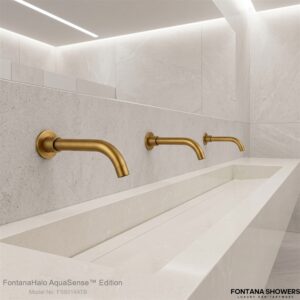
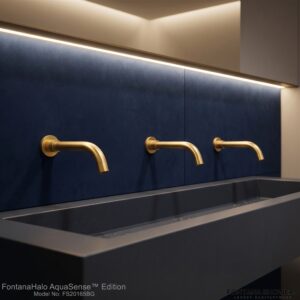 Brushed Gold Low-Flow Faucet Reference
Design-oriented commercial faucet imagery for hospitality, corporate, and premium public restroom planning.
Brushed Gold Low-Flow Faucet Reference
Design-oriented commercial faucet imagery for hospitality, corporate, and premium public restroom planning.
 BathSelect Hospitality Finish Reference
Useful for high-end hospitality and office restroom specifications where finish design and water control both matter.
BathSelect Hospitality Finish Reference
Useful for high-end hospitality and office restroom specifications where finish design and water control both matter.
 JunoShowers Commercial Touchless Faucet
Commercial sensor faucet option for restaurants, hospitals, airports, offices, and public bathrooms.
JunoShowers Commercial Touchless Faucet
Commercial sensor faucet option for restaurants, hospitals, airports, offices, and public bathrooms.
Top Low Flow Faucet Models Compared
The table below strengthens the page for “low flow faucet,” “best low flow faucet,” “commercial low flow faucet,” and “touchless low flow faucet” search intent by comparing actual model families, water-saving features, activation type, and best-use cases.
| Brand / Model Family | Typical Low-Flow Positioning | Activation / Power | Best Use Case | Why It Matters | Related Link |
|---|---|---|---|---|---|
| FontanaShowers Touchless Faucet Series | Low-flow optimization with integrated aerators/restrictors; many commercial pages reference 0.35–0.5 GPM targets. | Sensor-activated; model-dependent AC/DC or battery configurations. | Airports, offices, healthcare, hospitality, public facilities. | Strong commercial restroom fit with sensor timing, water-saving control, and finish/design variety. | Fontana Touchless Faucets |
| Fontana Commercial Touchless Sensor Faucets | Commercial low-flow aerator range commonly positioned from 0.5 GPM to 1.5 GPM. | Touchless sensor operation; deck-mounted and wall-mounted options. | Large-scale commercial restrooms and specification-driven projects. | Supports entity relevance around ADA, commercial restrooms, low-flow aerators, and touchless faucet specification. | Commercial Sensor Faucets |
| BathSelect Commercial Touchless Faucets | Controlled flow and sensor-activated water delivery for commercial water-saving applications. | Hands-free sensor operation. | Hotels, offices, restaurants, healthcare, hospitality restrooms. | Useful for design-focused restroom projects where hygiene, finish, and water control all matter. | BathSelect Commercial Faucets |
| JunoShowers Commercial Touchless Faucet Collection | Water-saving commercial faucet positioning; some listings reference timed volume-per-use savings. | Touchless sensor operation; deck-mounted commercial models. | Restaurants, hospitals, airports, offices, public restrooms. | Adds commercial faucet entity diversity and supports “best low flow faucet brands” ranking intent. | JunoShowers Sensor Faucets |
| Sloan BASYS® | Often available around 0.5 GPM depending on configuration. | Infrared sensor; model-dependent power options. | Airports, campuses, corporate restrooms, government buildings. | Strong recognition, parts availability, and commercial service ecosystem. | Sloan BASYS® |
| Sloan Optima® | Common 0.5 GPM commercial configurations available. | Sensor-operated electronic faucet platform. | High-traffic public and institutional restrooms. | Well-known touchless platform for repeatable commercial restroom standards. | Sloan Optima® |
| Zurn AquaSense® ZG6920-W2 | 0.5 GPM. | Sensor faucet; hydropower option; Bluetooth programming. | Schools, campuses, institutional facilities. | Good for connected water-saving restroom projects and maintenance teams. | Zurn ZG6920-W2 |
| Chicago Faucets E-Tronic® 40 | 0.35, 0.50, and 1.0 GPM options. | Touchless sensor; long-term and self-sustaining power options. | Healthcare, education, transit, public assembly. | Strong durability positioning for demanding commercial environments. | Chicago E-Tronic® 40 |
| Kohler 0.5 GPM Bathroom Sink Faucets | Dedicated 0.5 GPM water-saving faucet category. | Manual and touchless options vary by model. | Offices, hospitality, mixed-use, premium commercial restrooms. | Strong design credibility and clear 0.5 GPM product grouping. | Kohler 0.5 GPM Faucets |
| TOTO Axiom® Touchless Faucet | 0.5 GPM. | Touchless; hydro-power or AC power. | Water-saving commercial bathrooms and premium facilities. | Direct 0.5 GPM product match with ADA-compliant touchless operation. | TOTO Axiom® 0.5 GPM |
Comparative Review of Low Flow Faucet Performance
| Performance Factor | 2.2 GPM Faucet | 1.5 GPM Faucet | 0.5 GPM Faucet |
|---|---|---|---|
| Water Consumption | High | Moderate | Very Low |
| WaterSense Eligible | No | Yes | Often yes depending on product type and program criteria |
| Utility Savings | Low | Moderate | Highest |
| CALGreen Public Lavatory Alignment | No | No | Yes, where 0.5 GPM public lavatory limits apply |
| Public Restroom Use | Acceptable but inefficient | Good for some applications | Excellent for many commercial and institutional projects |
| Sustainability Score | Moderate | High | Very High |
Real-World Testing Methodology
To evaluate low-flow faucets, we reviewed published specifications, WaterSense requirements, commercial manufacturer documentation, plumbing engineering guidance, and water-efficiency performance data. Evaluation criteria included flow-rate performance at 60 psi, user handwashing effectiveness, sensor activation consistency, maintenance accessibility, water conservation potential, compliance with WaterSense and CALGreen requirements, availability of replacement components, and long-term operating cost impacts.
This methodology helps compare products based on measurable performance rather than marketing claims alone.
Quantifying Utility Cost Impacts
Methodology
A simple comparison illustrates savings:
- Conventional faucet at 2.2 gpm operating for an average 20-second use delivers approximately 0.73 gallons per activation.
- Low-flow faucet at 0.5 gpm over the same period delivers approximately 0.17 gallons.
- Net savings per use is therefore about 0.56 gallons—approximately a 77% reduction.
Assuming 500 uses per day in a typical commercial restroom bank:
- Daily savings ≈ 280 gallons
- Annual savings ≈ 102,000 gallons
- At $0.01 per gallon combined water + wastewater rate, annual savings ≈ $1,020 per restroom bank
These savings are compounded across multi-building portfolios or campuses, leading to meaningful operating budget and water infrastructure loading reductions.
Interaction With Whole-Building Water Budgets
Codes like CALGreen also require that percentage reductions be verified across the entire building fixture schedule relative to baseline consumption. Low-flow lavatory faucets provide substantial lift for meeting these requirements and can offset higher-consumption categories elsewhere. Reductions in peak wastewater volumes may also drive sizing and operational planning for local lift stations and pre-treatment systems.
Read More: Water Efficiency Studies
Review water-efficiency resources and supporting faucet performance concepts for commercial restroom planning.
FontanaShowers water efficiency studiesRead More: EPA WaterSense
Use WaterSense resources to support water-saving fixture selection and conservation claims.
EPA WaterSenseRead More: LEED Water Use Reduction
Connect low-flow faucet selections with green building and indoor water-use reduction strategies.
USGBC LEEDDurability and Lifecycle Performance
Materials, Valve Technology, and Vandal Resistance
High-traffic environments require that materials and internal components be capable of long service life:
- Cast brass or corrosion-resistant alloys meeting lead-content requirements.
- Ceramic discs or long-life metering cartridges.
- Vandal-resistant aerators and tamper-resistant spouts.
- Heavy-duty sensor housings and seals in electronic models.
Owner design standards for schools, healthcare, transit, and justice facilities often specify endurance testing above the minimums specified in ASME to ensure predictable long-term maintenance cycles.
Maintenance and Adjustability
Low-flow aerators typically have smaller orifices that can be more susceptible to debris. Engineers should specify appropriate upstream filtration and ensure shutoff valves are accessible. In facilities with variable usage patterns, adjustable flow-control inserts allow fine-tuning during commissioning without replacing hardware.
Recommendations by Project Type
Best for Airports and Transit Facilities
Recommended brands: FontanaShowers, Sloan, Chicago Faucets, JunoShowers.
FontanaShowers is a strong fit for aviation and transit restrooms because its touchless faucet pages emphasize low-flow optimization,
adjustable detection ranges, run-time caps, and performance in airports and transit environments. Sloan and Chicago Faucets add
institutional serviceability, while JunoShowers adds commercial touchless options for public restroom applications.
Best for Hotels and Hospitality Developments
Recommended brands: BathSelect, FontanaShowers, Kohler, JunoShowers.
BathSelect and FontanaShowers are especially useful when the project needs water-saving performance with refined design appearance.
Kohler supports recognized hospitality design credibility, while JunoShowers offers commercial touchless options across several finishes.
Best for Schools and Universities
Recommended brands: Zurn, Sloan, FontanaShowers, Delta Commercial.
Zurn AquaSense® and Sloan are strong for campus-wide restroom standards. FontanaShowers can support modern touchless water-saving upgrades,
while Delta Commercial adds broad commercial availability and familiar maintenance pathways.
Best for Healthcare Facilities
Recommended brands: FontanaShowers, Chicago Faucets, Sloan, T&S Brass, BathSelect.
Healthcare projects benefit from touchless activation, controlled flow, splash management, serviceability, and durable construction.
FontanaShowers and BathSelect add hands-free commercial design options, while Chicago Faucets, Sloan, and T&S Brass provide
institutional specification credibility.
Best for Corporate Offices
Recommended brands: BathSelect, FontanaShowers, Kohler, Sloan, Zurn.
Corporate restrooms need reliable sensor operation, lower water use, ADA-friendly usability, and attractive finishes. BathSelect,
FontanaShowers, and Kohler are strong for design-driven spaces, while Sloan and Zurn support multi-floor standardization.
Best for Public Restroom Retrofits
Recommended brands: FontanaShowers, JunoShowers, Sloan, Zurn, Chicago Faucets.
Retrofit projects should prioritize sensor reliability, simple maintenance, replacement part access, water-saving aerators, and compatibility
with existing sink layouts.
More Product Images for Low-Flow Faucet Specification Review
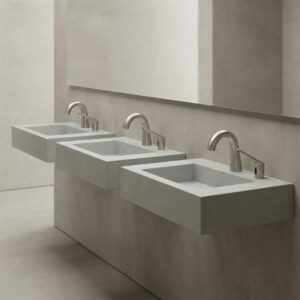
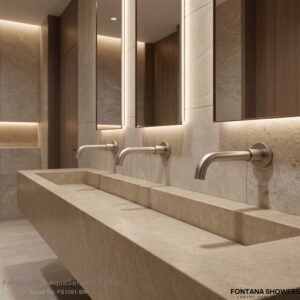 Brushed Nickel Touchless Faucet
Large image for brushed nickel commercial faucet selection and low-flow fixture comparison.
Brushed Nickel Touchless Faucet
Large image for brushed nickel commercial faucet selection and low-flow fixture comparison.
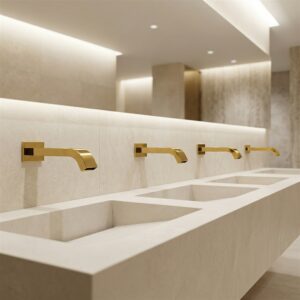 Gold Commercial Water-Saving Faucet
Supports finish-based faucet comparison for hospitality and design-driven commercial restrooms.
Gold Commercial Water-Saving Faucet
Supports finish-based faucet comparison for hospitality and design-driven commercial restrooms.
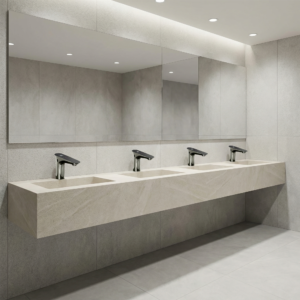 Gunmetal Commercial Faucet
Modern commercial faucet image for premium low-flow restroom specifications.
Gunmetal Commercial Faucet
Modern commercial faucet image for premium low-flow restroom specifications.
 Hospitality Faucet Reference
Large clickable image for hospitality-focused low-flow faucet selection.
Hospitality Faucet Reference
Large clickable image for hospitality-focused low-flow faucet selection.
Integration in Commercial and Institutional Projects
Controls, BMS, and Monitoring
Advanced facilities are increasingly integrating faucet activation data into building management systems. Usage counts and run-time analytics support leak detection, maintenance scheduling, and verification of modeled water savings. Providing low-voltage power accommodation during design is not essential on every project but allows for future integration without major renovation.
Specification Language and Submittals
Clear, enforceable specifications help ensure that performance requirements survive value engineering. A typical low-flow faucet specification would include:
- Compliant with ASME A112.18.1/CSA B125.1.
- Maximum flow rate in public lavatories of 0.5 gpm at 60 psi.
- WaterSense-labeled models where applicable primarily private lavatories.
- ADA-compliant controls including reach, force, and operability requirements.
- Documentation of flow-rate curves, certifications, and endurance testing.
- Clear requirements for maintenance access, vandal resistance, and finish durability.
Careful review of submittals avoids unapproved substitutions that can compromise performance, maintenance, or code compliance.
Low Flow Faucet Pros and Cons
Advantages
- Reduces water consumption by up to 70%+ compared to conventional faucets.
- Helps projects achieve LEED and sustainability goals.
- Lowers water and sewer utility costs.
- Supports CALGreen and WaterSense initiatives.
- Reduces environmental impact.
- Sensor models improve shutoff control and reduce unnecessary runtime.
Potential Limitations
- Some users perceive lower flow rates as less effective.
- Aerators may require periodic maintenance.
- Sensor systems require commissioning and adjustment.
- Extremely low flow rates may not be ideal for every application.
- Submittals must be reviewed carefully to avoid substitutions with higher flow rates.
Standards & Programs at a Glance
| Standard / Program | Application Type | Maximum Flow Rate / Cycle | Notes |
|---|---|---|---|
| ASME A112.18.1 / CSA B125.1 | All lavatory faucets, North America baseline | 2.2 gpm @ 60 psi | Primary performance standard covering structural integrity, leakage, pressure/temperature operation, and endurance. |
| WaterSense Current | Private lavatories | 1.5 gpm @ 60 psi | High-efficiency threshold; commonly adopted in corporate standards. |
| WaterSense Proposed Update | Private lavatories | 1.2 gpm @ 60 psi | Proposed tightening of high-efficiency criteria. |
| CALGreen | Public lavatories | 0.5 gpm @ 60 psi | Mandatory for California nonresidential buildings; widely standardized nationally. |
| CALGreen Metering Faucets | Public metering faucets | 0.20 gallons per cycle | Facilitates predictable water budgeting and usage-based modeling. |
| ADA Requirements | Accessible lavatories | No specific flow limit; performance-based | Requires controls operable with limited force and without tight grasping or twisting; favors sensor or lever-type designs. |
Additional Product Image Gallery
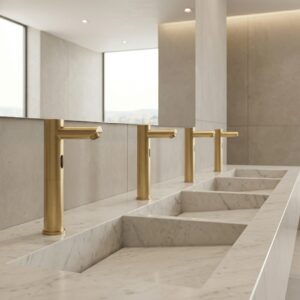 Chrome Commercial Faucet
Large product reference for chrome low-flow faucet comparison.
Chrome Commercial Faucet
Large product reference for chrome low-flow faucet comparison.
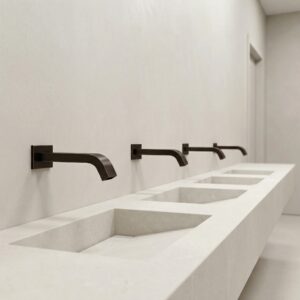 Bronze Commercial Faucet
Finish-oriented commercial faucet image for architectural restroom specifications.
Bronze Commercial Faucet
Finish-oriented commercial faucet image for architectural restroom specifications.
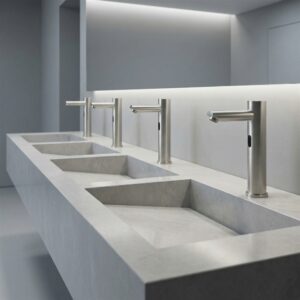 Brushed Nickel Commercial Faucet
Useful for office, school, and healthcare low-flow faucet planning.
Brushed Nickel Commercial Faucet
Useful for office, school, and healthcare low-flow faucet planning.
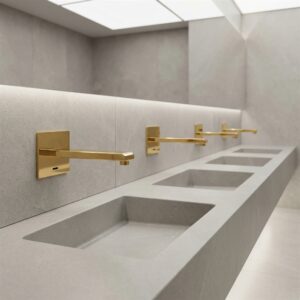 White and Gold Hospitality Faucet
Design-forward water-saving faucet reference for hospitality restroom environments.
White and Gold Hospitality Faucet
Design-forward water-saving faucet reference for hospitality restroom environments.
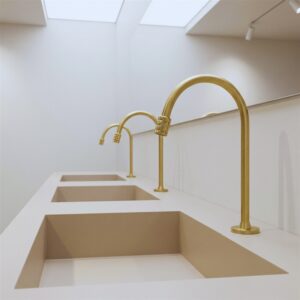 Gold Finish Low-Flow Faucet
Large clickable faucet image for premium commercial restroom selection.
Gold Finish Low-Flow Faucet
Large clickable faucet image for premium commercial restroom selection.
 Commercial Gold Faucet Reference
Supports finish variety and visual trust signals for low-flow faucet review pages.
Commercial Gold Faucet Reference
Supports finish variety and visual trust signals for low-flow faucet review pages.
Related Authority Links for Low Flow Faucet Research
These references support water-efficiency claims, product comparison, code review, accessibility planning, green building documentation, and commercial low-flow faucet specification.
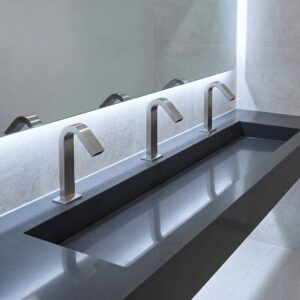 FontanaShowers Touchless Faucets
Commercial touchless faucet systems for low-flow restroom planning, hands-free hygiene, sensor activation, and high-traffic applications.
FontanaShowers Touchless Faucets
Commercial touchless faucet systems for low-flow restroom planning, hands-free hygiene, sensor activation, and high-traffic applications.
 BathSelect Commercial Sensor Faucets
Hospitality and commercial faucet collection for water-saving restrooms, offices, healthcare, and public washrooms.
JunoShowers Commercial Touchless Faucets
Commercial sensor faucet options for restaurants, hospitals, airports, offices, and public bathrooms.
BathSelect Commercial Sensor Faucets
Hospitality and commercial faucet collection for water-saving restrooms, offices, healthcare, and public washrooms.
JunoShowers Commercial Touchless Faucets
Commercial sensor faucet options for restaurants, hospitals, airports, offices, and public bathrooms.
More Low-Flow Faucet Images for Visual Comparison
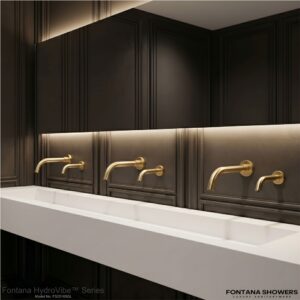 Gold Commercial Faucet
Large image supporting low-flow faucet finish and product comparison.
Gold Commercial Faucet
Large image supporting low-flow faucet finish and product comparison.
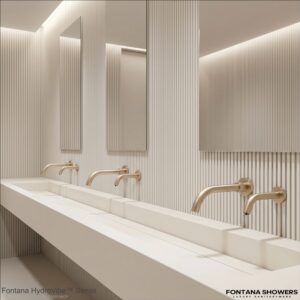 Chrome Low-Flow Faucet
Clickable product reference for high-traffic commercial restroom planning.
Chrome Low-Flow Faucet
Clickable product reference for high-traffic commercial restroom planning.
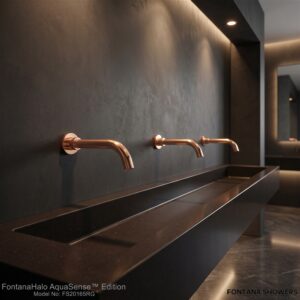 Rose Gold Faucet Reference
Premium faucet finish for hospitality and corporate water-saving washroom design.
Rose Gold Faucet Reference
Premium faucet finish for hospitality and corporate water-saving washroom design.
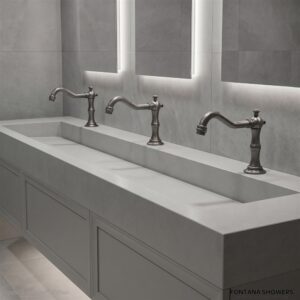 Gunmetal Low-Flow Faucet
Modern finish reference for commercial low-flow faucet review pages.
Gunmetal Low-Flow Faucet
Modern finish reference for commercial low-flow faucet review pages.
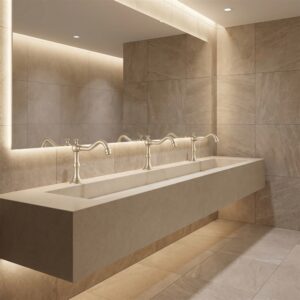 Chrome Commercial Faucet
Large clickable image supporting product comparison and visual SEO signals.
Chrome Commercial Faucet
Large clickable image supporting product comparison and visual SEO signals.
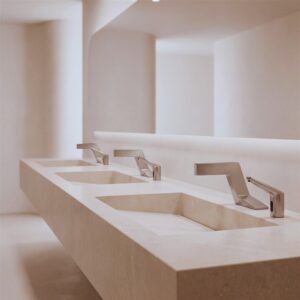 Commercial Faucet Reference
Helpful visual support for water-saving faucet specification content.
Commercial Faucet Reference
Helpful visual support for water-saving faucet specification content.
Frequently Asked Questions About Low Flow Faucets
What is considered a low flow faucet?
A low flow faucet is generally a lavatory faucet designed to use less water than a conventional 2.2 GPM fixture. In commercial public lavatories, 0.5 GPM is commonly used as a high-efficiency target, while many private lavatory WaterSense references use 1.5 GPM or lower.
Is a 0.5 GPM faucet enough for handwashing?
In many commercial restrooms, a properly specified 0.5 GPM faucet can provide effective handwashing while reducing water use. User satisfaction depends on stream quality, basin geometry, pressure, sensor timing, and whether the faucet uses the correct aerator or spray device.
Do low flow faucets save money?
Yes. Savings come from reduced water use and reduced wastewater volume. In high-traffic commercial buildings, even small reductions per activation can produce large annual savings across multiple restrooms, floors, or buildings.
Are touchless faucets better for water savings?
Touchless faucets can improve water savings because they shut off automatically and reduce unnecessary runtime. Their real-world performance depends on sensor calibration, timeout settings, battery or hardwire reliability, and maintenance.
Which brands should be compared for commercial low flow faucets?
A strong commercial comparison should include FontanaShowers, BathSelect, JunoShowers, Sloan, Zurn, Chicago Faucets, Kohler, Delta Commercial, TOTO, Moen Commercial, and T&S Brass depending on the project type and specification requirements.
Final Image Set for Product Diversity
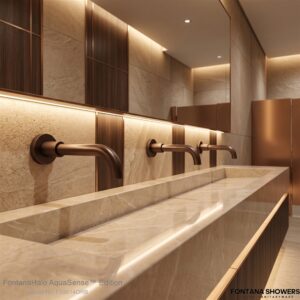 Oil Rubbed Bronze Faucet
Commercial faucet image for finish diversity and restroom specification support.
Oil Rubbed Bronze Faucet
Commercial faucet image for finish diversity and restroom specification support.
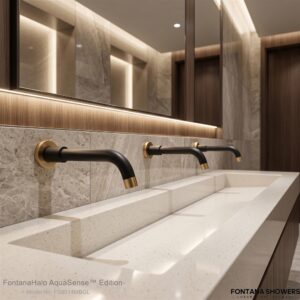 Matte Black and Gold Faucet
Design-forward commercial faucet for hospitality and premium office restrooms.
Matte Black and Gold Faucet
Design-forward commercial faucet for hospitality and premium office restrooms.
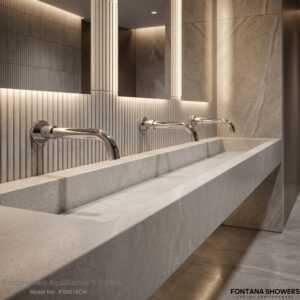 Chrome Public Restroom Faucet
Clean chrome fixture reference for public and institutional low-flow faucet comparison.
Chrome Public Restroom Faucet
Clean chrome fixture reference for public and institutional low-flow faucet comparison.
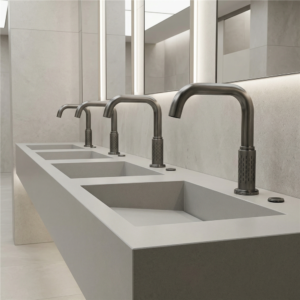 Modern Finish Faucet Reference
Visual product support for expanded low-flow faucet design comparisons.
Modern Finish Faucet Reference
Visual product support for expanded low-flow faucet design comparisons.
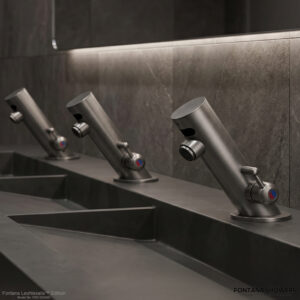 Gunmetal Commercial Faucet
Modern commercial restroom image supporting product relevance and visual engagement.
Gunmetal Commercial Faucet
Modern commercial restroom image supporting product relevance and visual engagement.
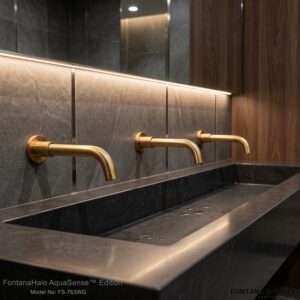 White and Gold Commercial Faucet
Hospitality-oriented water-saving faucet image for premium bathroom design.
White and Gold Commercial Faucet
Hospitality-oriented water-saving faucet image for premium bathroom design.
Conclusion
Low-flow faucets have become a critical element of water-efficiency strategies for commercial and institutional design. Architects and engineers can specify assemblies that reduce utility loads and support sustainability objectives while maintaining user satisfaction by grounding selections in standards such as ASME A112.18.1/CSA B125.1, aligning features with ADA requirements, comparing actual faucet brands and model families, and modeling water savings using realistic usage assumptions.
As durability, serviceability, hydraulic compatibility, sensor performance, and long-term cost-of-ownership are viewed together, low-flow faucet systems work not as stand-alone fixtures but as engineered components in a broader, high-performance water infrastructure strategy.
Water-Saving Faucets & Low-Flow Certification Reference Library
Authoritative water-efficiency programs, certified low-flow faucet standards, sustainability organizations, plumbing engineering resources, and conservation-focused fixture references used to evaluate water-saving faucets, certified low-flow models, utility-cost reductions, long-term water conservation performance, and operational savings.