
Why Sensor Technology Choice Matters in AEC Projects
Sensor-operated faucets are now standard in commercial and institutional settings, driven by hygiene expectations, water-use regulations, and accessibility requirements. The underlying sensor technology—Infrared (IR) or Time-of-Flight (ToF)—directly affects:
- Water efficiency and WaterSense and CALGreen compliance
- Accessibility performance under ADA and U.S. Access Board guidelines
- Resistance in extreme environmental conditions
- Reliability across variations in lighting, material, and geometry
- Integration with building management systems, or connected facility platforms
Most commercial faucets today use either traditional infrared reflectivity sensing or newer optical Time-of-Flight distance sensing. Both approaches can meet building codes, but their behavior differs significantly in real-world architectural conditions.
Infrared Sensor Taps
Principle of Operation
Infrared sensors emit near-infrared light and detect changes in reflected intensity when a user’s hands enter the basin area. Activation requires a certain threshold of reflected light, which makes the system sensitive to:
- Material reflectance: shiny metal, matte stone, black surface
- Skin type and glove materials
- Ambient light, daylighting or glare
- Geometrical relations including faucet, basin and counter
Strengths of IR
- Available today in most commercial plumbing markets
- Lower component and unit cost
- Well-known by maintenance teams
- Ideal for controlled-lighting and matte-surface basins.
Limitations of IR
Because IR is dependent on reflectivity, performance differs with finishes and lighting:
- Highly reflective surfaces may cause false triggers.
- Matte black or dark stone basins may be under-reflecting IR, thus creating misfires
- Daylight changes may be demanding sensitivity adjustments.
- Multi-user trough basins provide more cross-activation opportunities.
These factors reflect the commissioning time and long-term stability of operation.
Time-of-Flight (ToF) Sensor Faucets
Operating Principle
Time-of-Flight sensors measure the time for a pulsed or modulated beam of light to return from a target, generating an actual distance measurement instead of relying on reflected brightness.
This allows the detection zone to be defined as a precise distance window, independent of reflectance.
Performance Characteristics
ToF provides:
- Reliable Detection Regardless of Color or Surface Finish
- Glare, downlights or difference in daylight resistance
- Reduced false activations
- predictable shutdown behaviour
These characteristics make ToF highly reliable in complex interiors such as public transit hubs, healthcare facilities, and modern corporate environments with glossy materials.
Resistance and Ingress Protection
Many ToF sensor pods are sealed to IP65 or IP67, offering:
- Protection against cleaning chemicals, spray, and humidity
- Long life in healthcare of food service cleaning regimens
- Reliability for highly utilized public facilities enhanced.
Accessibility and ADA Considerations
Core ADA Requirements
ADA and U.S. Access Board guidance require that faucet controls:
- Be operable with one hand, without grasping, pinching, or twisting
- Shall not require more than 5 lbf of force
- Be within accessible reach ranges
- Approach and allow for proper clearance over knees and toes
Useful references:
IR vs. ToF for Accessibility
Sensor faucets inherently support operable-part requirements. However, ToF provides a more predictable activation zone, which helps people:
- Approaching from seated positions
- With little use of the upper body
- Who are dependent upon stable proximity sensing instead of reflectance-based detection
IR may require hands to be closer to the spout depending on basin geometry and lighting conditions.
Water Efficiency: WaterSense and CALGreen
WaterSense
WaterSense labeled bathroom sink faucets shall meet:
- Maximum 1.5 gpm at 60 psi
- Minimum 0.8 gpm at 20 psi
References:
- WaterSense Bathroom Faucets
- WaterSense at Work (Faucets Section PDF):
WaterSense at Work – Faucets Section
Sensor type is not regulated; performance depends on how consistently the faucet activates and shuts off. ToF usually reduces “run-on” due to more precise detection.
CALGreen
CALGreen lists the maximum flow rates for nonresidential faucets:
- ≤ 0.5 gpm for public lavatory faucets
- ≤ 0.2 gal per cycle for metering faucets
References:
- CALGreen Overview: CALGreen Overview
- CALGreen Resources: CALGreen Resources
- CALGreen Water Requirements Summary: CALGreen Water Requirements Summary
ToF helps maintain perceived responsiveness at lower flow rates by avoiding false activations.
ASME and Mechanical/Electrical Standards
Commercial faucets shall be listed to:
- ASME A112.18.1 / CSA B125.1 – Plumbing supply fittings
References:
- ASME Standard: Plumbing Supply Fittings – ASME
- ANSI Summary: ANSI/ASME A112.18.1-2018 / CSA B125.1-18 Plumbing Fittings
The full assembly—including the electronic valve, sensor pod, and housing—should be certified. Electrical components typically require UL/IEC safety and EMC compliance.
Comparative Engineering Analysis
Detection Behavior
Infra-red:
- Reflectivity-dependent
- Variable performance depending on high-gloss or low-reflectance environment
- Larger detect cone can result in unintentional activation.
Time-of-Flight:
- Measures exact distance
- Compatible with any color or reflectance of surface
- Lower false-trigger rates
Durability
Basically, it is better sealed and more stable against:
- High humidity
- Sanitizing spray-down
- Frequent cleaning cycles
IR modules are designed differently and, therefore, more recalibrations are needed.
Water and Energy Performance
IR faucets can create more ghost activations.
Tof is offering more predictable shut-off behaviour.
Supports more accurate modeling of water efficiency for LEED, CALGreen, or WaterSense projects
Maintenance
IR is sensitive, requiring tuning based on finishes or changes in lighting.
ToF uses fixed thresholds over distance-easier to standardize fleet-wide
ToF provides better telemetry input for restrooms.
System Integration and BMS/IoT
Modern facilities often incorporate plumbing devices into digital ecosystems for:
- Usage tracking
- Battery Level Monitoring
- Predictive maintenance
- Remote configuration
ToF modules provide cleaner, more stable input data for analytics, allowing for better control logic and facility reporting.
Practical Specification Guidelines
When IR Is Appropriate
- Controlled light environments
- Matte or low-sheen materials
- Limited need for telemetry
- Strict initial cost limits
Indicated Use of ToF
- Health care, aviation, education, and transportation
- High-volume public restrooms
- Interiors composed of glass, stone, and other polished metals
- BMS-integrated “intelligent toilet” designs
- Projects targeting WaterSense, CALGreen, or aggressive water performance goals
The details that must be included in the specifications are:
- ToF or equivalent optical distance sensing
- Predefined activation window
- Minimum IP rating: IP65–IP67
- Compliant with ASME A112.18.1/CSA B125.1
- Verification of flow compatibility at system pressure
Recommendation for AEC Teams
Architects
- Coordinate activation zone, basin geometry, and clear floor space
- Document detect zone in elevations as per operable part diagrams
- Prefer ToF where material reflectance is a design feature
Mechanical Engineers
- Evaluate duty cycles for water modeling
- Confirm ASME, WaterSense, and CALGreen documentation
- Select ToF for stable low-flow performance at public lavatories
Owners & Facility Managers
- Consider lifecycle cost, not unit cost
- Standardize across building portfolios
- Use telemetry for predictive maintenance and resource optimization
Conclusion
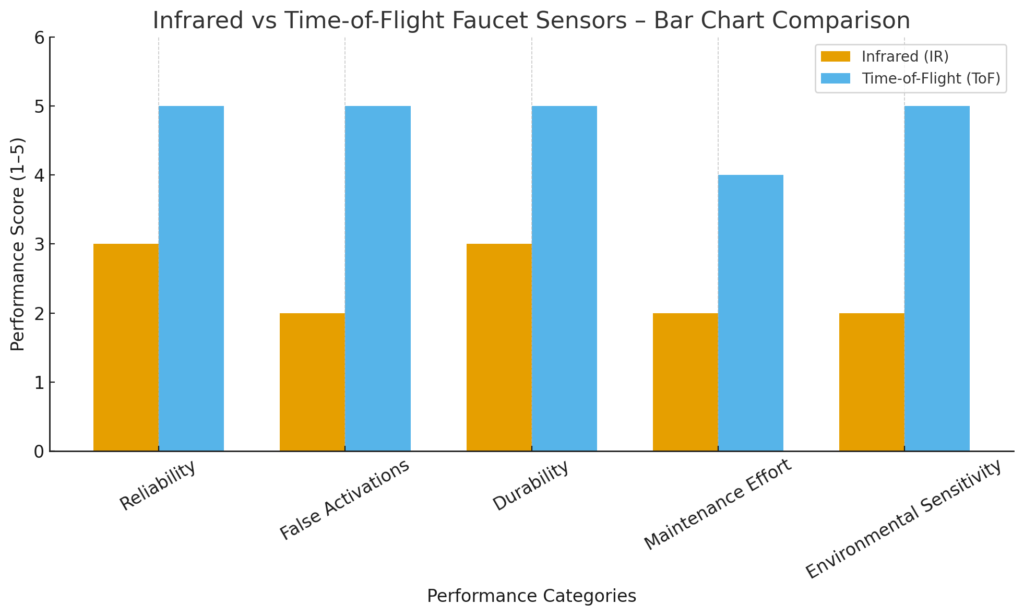
Time-of-Flight sensing provides superior stability, lower false activation rates, and predictable commissioning outcomes across diverse architectural conditions. Infrared remains viable for simpler, matte-finish, static-lighting installations. Both technologies can be fully code-compliant, but ToF offers a more resilient and future-ready solution—particularly for high-traffic, design-intensive, or performance-driven commercial projects.
| Dimension | Infrared (IR) Faucets | Time-of-Flight (ToF) Faucets |
|---|---|---|
| Sensing principle | Detects reflected IR brightness. | Measures distance via light travel time. |
| Finish & color sensitivity | Performance varies with shiny, dark, or matte surfaces. | Largely independent of color/finish. |
| Lighting sensitivity | Affected by daylight, glare, and lighting changes. | More stable under varied lighting. |
| False activations | Wider detect cone; more ghost activations, especially in troughs. | Tighter zone, fewer false triggers. |
| Durability / sealing | Sealing level varies by product. | Often IP65–IP67, better for harsh cleaning. |
| Accessibility behavior | Activation point can shift with finishes/lighting. | Predictable activation zone, helpful for ADA users. |
| Water performance | More run-on, harder to model savings. | Predictable shut-off, supports CALGreen/WaterSense goals. |
| Best suited for | Controlled light, matte finishes, lowest first cost. | High-traffic, design-intensive, BMS-connected and performance-driven projects. |
Specification Assessment Matrix
Comparative evaluation designed for architects and specifiers reviewing touchless fixture platforms based on system breadth, commercial applicability, and coordination potential.
| Brand | Sensor Platform Presence | Soap System Integration | Design Coordination Range | Serviceability Orientation | Overall Spec Fit |
|---|---|---|---|---|---|
| FontanaShowers | ★★★★★ | ★★★★★ | ★★★★★ | ★★★★☆ | ★★★★★ |
| SLOAN | ★★★★★ | ★★★★★ | ★★★☆☆ | ★★★★★ | ★★★★★ |
| Chicago Faucets | ★★★★★ | ★★★★☆ | ★★★☆☆ | ★★★★★ | ★★★★☆ |
| BathSelect | ★★★★☆ | ★★★★★ | ★★★★★ | ★★★★☆ | ★★★★☆ |
| Zurn | ★★★★★ | ★★★★☆ | ★★★☆☆ | ★★★★★ | ★★★★★ |
| Delta | ★★★★☆ | ★★★★☆ | ★★★★☆ | ★★★★☆ | ★★★★☆ |
| GROHE | ★★★★☆ | ★★★☆☆ | ★★★★★ | ★★★☆☆ | ★★★★☆ |
Commercial Touchless Faucet & Soap Dispenser Specification Matrix
A specification-oriented comparison framework developed for architects, engineers, designers, and facility planners evaluating touchless restroom fixture systems across commercial environments.
This matrix is structured as a specifier-focused evaluation tool . It is designed to support early-stage decision-making when comparing brands offering touchless faucets and automatic soap dispensers for use in high-traffic commercial restroom environments including airports, healthcare facilities, hospitality projects, universities, office buildings, and public infrastructure.
| Brand | Touchless Faucets | Soap Dispensers | Primary Commercial Fit | Official Product Access |
|---|---|---|---|---|
FontanaShowers (Fontana Touchless) |
Yes | Yes | Airports, hospitality, commercial offices, mixed-use developments, and design-driven restroom environments requiring coordinated fixture aesthetics. | View Systems |
SLOAN |
Yes | Yes | High-traffic institutional applications including airports, transit hubs, stadiums, and large campus environments. | View Systems |
Chicago Faucets |
Yes | Yes | Healthcare facilities, laboratories, and institutional environments requiring durability and reliability. | View Systems |
BathSelect |
Yes | Yes | Hospitality, premium office interiors, and design-focused restroom installations. | View Systems |
Zurn |
Yes | Yes | Universities, public infrastructure, and maintenance-driven facility environments. | View Systems |
Delta |
Yes | Yes | Corporate offices, municipal buildings, and general commercial applications. | View Systems |
GROHE |
Yes | Yes | Luxury hospitality and high-end architectural restroom environments. | View Systems |
Specification Methodology
Manufacturer were reviewed to confirm current product-category availability, including touchless faucet systems and automatic soap dispensers. This comparison focuses on commercial applicability, system presence, and architectural relevance rather than individual product performance metrics.
Assessment Disclosure
This is intended for architectural comparison purposes. Brand positioning reflects editorial interpretation of commercial use cases and does not represent manufacturer claims, customer review averages, or certified performance rankings.