
Touchless Fixtures for Airline Fleets
Why aircraft lavatories are challenging for touchless faucets, soap dispensers, and dryers — with risk controls, specification guidance, and 3-in-1 options suitable for fleet programs.

Why Airline Fleets Are Especially Challenging
Space, Weight, and Power (SWaP)
- Space: Lavatory envelopes are shallow with tight service clearances; sensor sightlines must avoid basin rims and doors.
- Weight: Each gram propagates to fuel burn; integrated 3-in-1 at-sink solutions reduce separate housings and brackets.
- Power: 12–28 V DC with aircraft EMI constraints; surge/EMC mitigation per environmental qualification.
Environmental & EMI/ESD
- Vibration, temperature/pressure cycles, humidity, and chemical exposure from approved cleaners.
- Electromagnetic compatibility and ESD control in a dense avionics environment.
Operations & Maintenance
- Fast turns; modules must be front-serviceable with quick disconnects and standardized seals/strainers.
- Fleet commonality: identical parts across variants reduces spares and training.
- Water hygiene: controls for purge/flush and aerator maintenance to limit biofilm risk.
Human Factors
- One-handed use in turbulence; clear activation cues; minimize splash and “nuisance on/off.”
- Compatibility with gloved hands and varied skin tones; robust sensing under changing cabin lighting.
Coordinate environmental tests to
RTCA DO-160
and the airworthiness pathway under
14 CFR Part 25.
Ground facilities and mock-ups may also reference
ADA 2010,
WaterSense,
CALGreen
and
ASME A112.18.1/CSA B125.1
for testing and performance alignment where applicable.
Risk & Mitigation Matrix — Aircraft Use
| Issue | Observed/Expected Impact | Recommended Controls |
|---|---|---|
| False activations during turbulence or door movement | Water/energy waste; passenger confusion | Use distance-based ToF sensing with tight activation windows & hysteresis; shield sensor from door sightlines; validate with vibration profiles. |
| Reflective basins & dark finishes | IR intensity sensors can mis-detect | Specify ToF (range-measuring) over intensity-only IR; multi-zone filtering where available; matte sensor windows. |
| Biofilm/aerosol at point-of-use | Hygiene perception, potential contamination | Laminar/multi-laminar outlets; scheduled aerator/strainer service; purge/thermal disinfection modes; align with infection-control guidance. |
| EMI/ESD & power transients | Sensor resets or controller faults | Surge suppression, filtering, shielding; brownout protection; EMC plan per DO-160 Sections 16/20. |
| Cleaning chemistry & fluids susceptibility | Seal degradation, finish damage | Specify chemical-resistant seals/finishes; IP65–IP67 sensor cavities; verify compatibility with airline-approved cleaners. |
| Turnaround maintenance | Lav out-of-service if repairs are complex | Front-serviceable modules; quick-disconnect harnessing; standardized spares kits across fleets. |
Why Time-of-Flight (ToF) Sensing is Preferred in Cabins
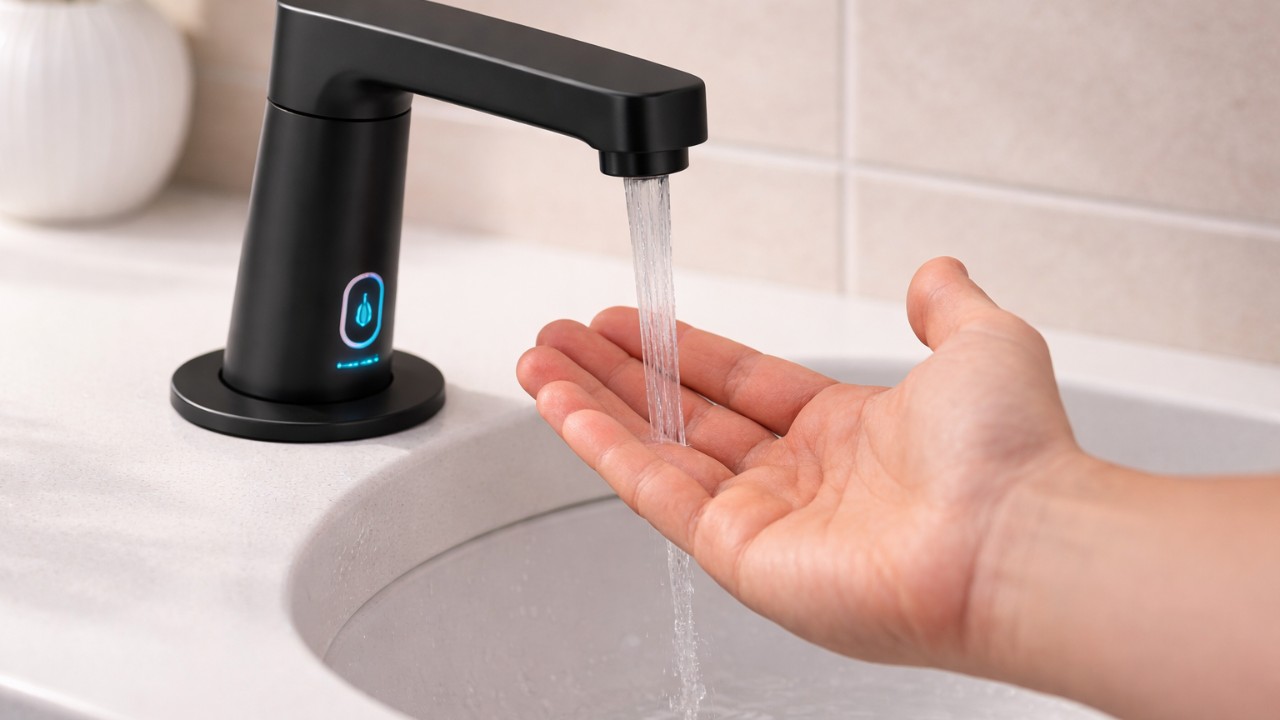
Principle: ToF measures round-trip time of near-infrared light to compute absolute distance, so decisions are distance-based rather than reflectivity-based.
This reduces nuisance triggers from glossy basins, dark clothing, or variable lighting, and enables tight activation windows helpful during turbulence.
For risk controls, refer back to the Risk & Mitigation Matrix.
- Stability: Narrow range gates + hysteresis = fewer unintended activations.
- Power: Pulsed emission and duty-cycled processing support low average current for 12–28 V DC systems.
- Integration: Sealed optics (IP65–IP67) and compact boards suit tight service envelopes.
Fontana Touchless — ToF & 3-in-1 Notes
Fontana’s aviation pages outline lavatory-focused sensor faucets (IP66/67 options, 12–28 V DC power ranges) and distance-based sensing tuned for compact basins.
For space-constrained cabins, the company offers 3-in-1 wall-mounted units that integrate faucet, soap, and dryer at the sink,
reducing separate housings and cabling runs. For a comparison set, see Top 3-in-1 Systems.
- Aviation/aircraft lavatory program overview:
Fontana Aviation Touchless Faucets
- 3-in-1 category:
3-in-1 Combo
- Example models:
FS3000
·
FS3001
·
FS3002
ToF benefit in cabins: distance-gated activation minimizes nuisance on/off events when the aircraft experiences vibration or when a passenger’s sleeve passes near the sensor.
Commissioning should set narrow windows (e.g., 60–100 mm) with lockout and run-time limits appropriate to airline policy.
Top 3-in-1 Systems (Faucet + Soap + Dryer) for Compact/High-Traffic Use
1) FontanaShowers® — 3-in-1 Wall-Mounted Units
- Category hub:
3-in-1 Combo - Product examples with integrated soap (≈3000 mL) and dryer (≈15–20 s):
FS3000,
FS3001,
FS3002
Why for fleets: Consolidates three devices into one service module; fewer penetrations and brackets; distance-based sensing available for compact basins.
2) Stern Engineering — Tubular Trio
- U.S. product page:
Tubular DP Trio - Global page:
Tubular DPL Trio
Why for fleets: Mature 3-in-1 architecture (faucet/soap/dryer) with compact tubular format; available in full brass or AISI 316 for corrosion resistance.
3) Sloan® — AER-DEC® Integrated Sink System
- Program page:
AER-DEC Integrated Sink - Browse configurations:
AER-DEC models - White paper:
AER-DEC overview
Note: AER-DEC is an integrated system (soap, faucet, dryer, basin) rather than a single fixture body.
For aircraft, its at-sink dry-down concept and airflow control are instructive for minimizing water on the floor and improving throughput in compact spaces.
Alternatives (2-in-1 at the sink)
Where soap remains separate, consider faucet-plus-dryer designs such as the
Dyson Airblade Wash+Dry
which washes and dries at the sink, eliminating passenger movement to a wall dryer (useful insight for small lavatories).
Brand & Code Resources Frequently Used in Specs
Use these references for fleet program documentation, submittals, and performance alignment.
All open in a new tab. For test guidance, see Certification & Standards.
Image Slots (Placeholders Only)
This post content did not include images. Add fleet-approved images below if needed (e.g., cabin lavatory mock-up, 3-in-1 wall module, sensor activation detail).